Buying Hay
What to Look for When Buying Hay for Horses: A Complete Buyer’s Guide
Aug
Last updated: August 22, 2026
Buying hay for a horse isn’t as simple as choosing the greenest bale or the lowest price.
Good horse hay should be clean, properly cured, pleasant-smelling, low in dust, free from visible mold and appropriate for the horse eating it. Beyond those basic checks, the type and nutritional value of the forage need to match the horse’s age, workload, body condition and overall diet.
Oregon State University Extension recommends evaluating hay using a combination of sensory inspection and chemical analysis. Looking at the hay tells you about maturity, leafiness, color, odor and foreign material. A forage analysis gives you much better information about protein, fiber, moisture and other nutritional characteristics.
That distinction matters because two bales can look almost identical while providing different amounts of energy, protein and other nutrients.
If you’re standing in front of a stack of bales wondering which one to buy, here’s what to check.
What should you look for when buying horse hay?
Start with these 12 factors:
- Hay type and forage species
- Maturity at harvest
- Leaf-to-stem ratio
- Color
- Smell
- Dust and mold
- Weeds and foreign material
- Moisture and curing
- Nutritional analysis
- Bale consistency
- Price by weight
- Your horse’s individual needs
A good-looking bale isn’t automatically good feed. Hay quality has both physical and nutritional components. Physical inspection is useful, but laboratory testing gives you a more reliable picture of nutritional value.
1. Start with your horse, not the bale
Before inspecting the hay, think about what your horse needs.
There isn’t one type of hay that’s best for every horse. A mature horse at maintenance has different nutritional requirements from a growing youngster, lactating mare or hard-working performance horse. Age, body weight, workload and reproductive status all affect nutrient requirements.
Consider:
- Age
- Body condition
- Workload
- Growth or reproduction
- Weight-management needs
- Dietary concerns
- Pasture access
- Other feeds and supplements
For example, an easy keeper often doesn’t need highly energy-dense forage. A growing horse has greater requirements for nutrients involved in growth, while a lactating mare has additional nutrient demands.
The goal isn’t to find the hay with the highest protein or the brightest green color.
The goal is to find clean, nutritious forage that fits the horse’s overall ration.
2. Identify the type of hay
Common horse hays include timothy, orchardgrass, bermudagrass, fescue, teff, oat hay, alfalfa, clover and grass-legume mixtures.
The forage species matters, but so do maturity, harvest conditions and storage.
Grass hay
Grass hay is often a good option for horses needing forage without the greater nutrient density found in many legume hays.
Common examples include:
- Timothy
- Orchardgrass
- Bermudagrass
- Fescue
- Teff
- Oat hay
Don’t stop at the species name, though. Hay from the same species can vary substantially depending on when it was harvested and how it was handled.
If you’re comparing different types of grass forage, you can review our grass hay for horses options as part of your comparison.
Legume hay
Alfalfa and clover are common legume hays. Legumes generally provide more nutrient-dense forage than many grasses.
For horses with higher nutrient requirements, this can be useful. For an easy keeper, the added nutrient density isn’t always necessary.
That doesn’t make alfalfa “better” or grass hay “better.” It means the forage needs to fit the horse.
You can compare legume hay for horses based on your horse’s nutritional requirements rather than choosing solely by appearance.
Mixed hay
Grass-legume mixtures can provide a useful middle ground.
A grass-and-alfalfa mix, for example, can provide more nutrients than mature grass hay without having the same nutrient concentration as straight alfalfa.
The proportions matter, as does the maturity of the plants when they were harvested.
For horses where a mixed forage fits the feeding plan, you can also compare mixed hay options for horses.
3. Check the maturity
Maturity is one of the most important factors affecting hay quality.
As forage plants mature, stems become more prominent and the proportion of fiber generally increases. More mature forage tends to have lower digestibility and lower nutrient density than less mature forage.
Look for:
- Fine or coarse stems
- Seed heads
- Flowers
- Leaf abundance
- Overall texture
For grass hay, numerous mature seed heads can indicate later harvesting.
With alfalfa, look at stem thickness and leaf abundance rather than relying only on the number of flowers. Oregon State University notes that mature alfalfa develops larger, woodier stems and loses leaves as it advances in maturity.
Don’t reject a bale because you spot a few seed heads. Look at the overall maturity of the hay.
4. Look for plenty of leaves
Open the bale and examine the relationship between leaves and stems.
Leafiness is an important part of hay evaluation. Leaves generally contain more nutrients than mature stems, and leaf loss during harvesting and handling reduces the value of the forage.
Good signs include:
- Plenty of leaves
- Fine or moderately fine stems
- Leaves still attached to stems
- Hay with a reasonably pliable texture
Watch out for:
- Thick, coarse stems
- Very few leaves
- Large amounts of loose leaf material
- Extremely brittle hay
- Excessive stem-to-leaf ratio
Loose leaves on the floor aren’t necessarily a sign of poor hay by themselves. They can indicate leaf shatter during harvesting, handling or storage, especially with legume hay.
Don’t inspect only one bale. Open several bales from the lot when possible.
5. Use color as a clue, not a verdict
Good hay is often green or greenish, but color alone doesn’t determine nutritional quality.
Sun exposure, maturity, weather and storage all affect color. A bale can be slightly bleached on the outside while remaining greener inside.
Brown or unusually dark hay deserves closer inspection, especially when accompanied by a musty odor, heating or evidence of moisture damage. Oregon State University identifies brown, moisture-damaged hay with a musty odor as a quality concern.
So don’t make your decision based on color alone.
Look at color alongside smell, texture, maturity, dust, mold and the overall condition of the bale.
6. Smell the hay
Your nose is one of the easiest tools you have when buying hay.
Good hay should smell fresh and pleasant, similar to freshly cut or cured hay. Avoid forage with a musty, moldy, sour or rotten odor.
Open the bale and smell the inside rather than relying on the outer surface. Oregon State University specifically recommends smelling the middle of the bale when evaluating hay.
If the interior smells wrong, take it seriously.
A bale can look fine from the outside while having poor-quality material inside.
7. Check for dust and mold
Dust and mold are good reasons to reject a bale.
Break open the bale and inspect the interior. Look for:
- Visible mold
- Unusual discoloration
- Excessive dust
- Musty odors
- Damp or heated areas
Good hay should be clean, dry and reasonably low in dust.
Shake a flake lightly. A small amount of loose material isn’t unusual, but a noticeable cloud of dust deserves attention.
Horses with respiratory problems are especially sensitive to airborne dust and mold particles, so forage quality becomes even more important for these animals.
Don’t rely on soaking or steaming to turn poor hay into good hay. Starting with clean forage is the better approach.
8. Look for weeds and foreign material
Inspect the bale for unwanted plants and debris.
Watch for:
- Toxic weeds
- Thorny or sharp plants
- Dirt
- Sticks
- Wire
- Plastic
- Nails or other debris
- Insects
- Other contaminated material
Some weeds have little feed value, while others are potentially toxic. Foreign objects such as wire or sharp debris create a separate physical hazard.
The University of Georgia Extension Forage Team recommends avoiding hay containing excessive weeds or foreign material and points out that certain forage toxins can remain a concern after plants are harvested.
Ask where the hay was grown
The growing region can matter.
Certain forage hazards are more common in particular areas. Blister beetles, for example, can occasionally contaminate alfalfa hay in some regions.
Ask the supplier where the hay came from and whether there were any known issues in the field or during harvest.
9. Ask about moisture and curing
Hay needs to be properly cured before storage.
Hay baled with too much moisture can heat, mold and lose quality. At higher moisture levels, excessive heating can also create a serious fire hazard.
University of Minnesota Extension lists 10% to 15% moisture as the optimum range for horse hay. Hay above 16% has an increasing risk of mold without appropriate preservation, while hay above 25% moisture presents a much greater risk of severe heating and fire.
Those figures aren’t a substitute for inspecting the individual lot. Bale density, forage type, storage conditions and preservation methods all matter.
Ask the seller:
- When was the hay cut?
- When was it baled?
- Did it get rained on?
- Was a preservative used?
- How was it stored?
- Was the moisture tested?
University of Minnesota research also shows how moisture at baling affects mold development and forage quality, particularly in orchardgrass.
10. Inspect the inside of the bale
One of the easiest mistakes is judging hay from the outside.
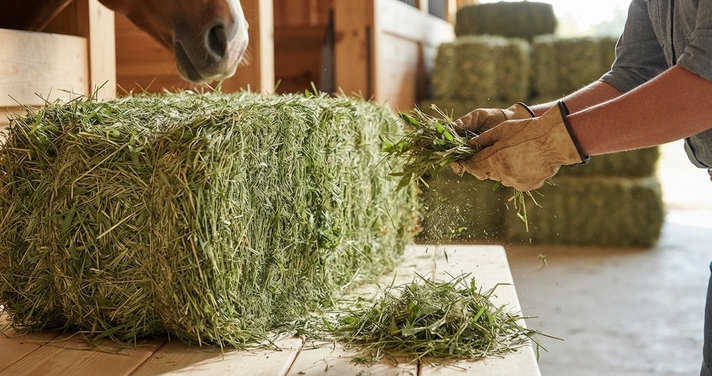
The outside of a bale is exposed to different conditions from the center. Open the bale whenever possible and check the material your horse will actually eat.
A quick inspection should include:
- Open several bales.
- Examine the middle.
- Smell the interior.
- Look for mold and discoloration.
- Check the leaf-to-stem ratio.
- Feel the texture.
- Look for weeds and foreign material.
If the seller won’t allow reasonable inspection before a large purchase, think carefully before committing.
11. Inspect several bales
One good bale doesn’t guarantee a good load.
When buying a significant quantity, ask whether the hay comes from the same:
- Field
- Cutting
- Harvest period
- Weather conditions
- Storage conditions
A “lot” of hay generally refers to forage from the same field or cutting that has been handled under similar conditions. Oregon State University recommends sampling hay lots rather than treating one bale as representative of an entire purchase.
The larger the purchase, the more important consistency becomes.
12. Get a forage analysis when nutrition matters
Visual inspection tells you a lot about physical quality, but it doesn’t tell you everything your horse is eating.
A forage analysis can provide information about:
- Moisture
- Crude protein
- ADF
- NDF
- Energy
- Calcium
- Phosphorus
- Sugar and starch, depending on the testing package
- Other nutrients included by the laboratory
University of Minnesota Extension recommends requesting a horse-specific hay analysis when submitting samples. It also recommends using a separate analysis for each distinct field or cutting.
Forage testing becomes especially useful when:
- You’re buying a large quantity
- Your horse has specific nutritional needs
- You’re trying to control calories
- You’re managing carbohydrate intake
- You’re balancing a ration
- The hay’s quality is difficult to judge visually
Two bales can look equally green, leafy and clean while having different nutritional profiles.
Your eyes tell you about physical quality. A laboratory analysis gives you a much better picture of nutritional quality.
13. Learn the basic numbers on a hay analysis
A forage report can look confusing at first, but several measurements are especially useful.
Crude protein
Crude protein gives you an estimate of protein concentration.
More protein isn’t automatically better. The appropriate amount depends on the horse and the rest of the ration.
University of Minnesota Extension lists typical crude protein ranges of about 8% to 14% for grass hays and 15% to above 20% for legume hays, though individual samples vary.
ADF
Acid detergent fiber, or ADF, is associated with forage digestibility.
As ADF increases, digestibility generally decreases.
NDF
Neutral detergent fiber, or NDF, relates to the bulkiness of forage and voluntary intake.
Higher NDF generally means a horse consumes less of the forage.
Nonstructural carbohydrates
For horses requiring controlled sugar and starch intake, the carbohydrate profile deserves particular attention.
Depending on the laboratory, a report might include water-soluble carbohydrates, ethanol-soluble carbohydrates, starch or nonstructural carbohydrates.
Don’t try to estimate these values from the color of the hay. Test the forage when carbohydrate control is important.
14. Match the hay to the horse
The same hay can work well for one horse and poorly for another.
Easy keepers
An easy keeper often doesn’t need highly energy-dense forage. A suitable grass hay can be a better fit than nutrient-dense legume hay.
Growing horses
Young horses have different nutrient requirements from mature horses. Protein, minerals and energy all need to be considered.
Performance horses
Hard-working horses often need more energy, depending on workload and forage quality. Forage remains important, but additional feed might be needed to meet higher energy demands.
Older horses
Older horses that struggle to chew coarse forage need hay with a texture they can comfortably consume.
Horses needing controlled carbohydrates
For horses with specific metabolic or laminitis-related concerns, forage carbohydrate levels can become an important selection factor.
A laboratory analysis gives you information visual inspection can’t provide.
15. Don’t assume “horse quality” means best for your horse
“Horse quality” sounds reassuring, but the phrase doesn’t tell you enough.
The University of Georgia Extension Forage Team notes that “horse quality” often describes the visual characteristics of hay rather than whether the forage meets the nutritional requirements of a particular horse. A pleasure horse, lactating mare and growing youngster can have very different nutritional needs.
Instead of asking:
“Is this horse-quality hay?”
Ask:
“Is this clean, safe, nutritious hay appropriate for my horse?”
That’s a much better buying question.
16. Compare hay by weight
A cheaper bale isn’t always the cheaper option.
For example:
- 35-pound bale for $5 = about $0.14 per pound
- 50-pound bale for $6 = $0.12 per pound
The $6 bale costs more at checkout, but less per pound.
Use this formula:
Price per pound = Bale price ÷ Bale weight
For larger purchases, comparing cost per ton gives you an even clearer picture.
Also ask about delivery charges. A low bale price doesn’t mean much if delivery adds a large amount to the final cost.
17. Factor waste into the price
The cheapest hay isn’t a bargain if your horse refuses a large portion of it.
Poor-quality hay can be wasted because it’s:
- Too coarse
- Dusty
- Moldy
- Unpalatable
- Excessively mature
Oregon State University notes that higher-quality hay can sometimes be the better economic choice because less hay is needed to meet nutritional requirements and less is wasted.
When comparing prices, think about how much of the hay your horse will actually consume.
18. Ask the seller the right questions
Before committing to a large purchase, ask about both the hay and the supplier.
About the hay
- What species does it contain?
- Is it grass, legume or mixed?
- What cutting is it?
- When was it harvested?
- Was it rained on?
- Where was it grown?
- Was a preservative used?
About quality
- Has the hay been tested?
- Is a current forage analysis available?
- What is the moisture level?
- Does the hay come from one consistent lot?
- How has it been stored?
About the purchase
- How much does each bale weigh?
- What’s the price per bale?
- What’s the price per ton?
- Can I inspect several bales?
- What are the delivery charges?
- What happens if the delivered hay doesn’t match the sample?
A reliable supplier should be willing to answer reasonable questions and explain what you’re buying.
19. Try a small purchase first
If you’re buying from a new supplier, start with a few bales when possible.
Oregon State University specifically suggests buying a few bales and observing whether horses eat the forage well before committing to a truckload.
A small trial helps you determine whether:
- Your horse eats the hay willingly
- Your horse wastes much of it
- Quality stays consistent
- Body condition remains appropriate
- The hay works well as part of the overall ration
A trial purchase is especially useful when ordering hay from a new supplier.
20. Check how the hay was stored
Good hay can deteriorate after harvest if stored poorly.
Ask where and how the hay has been stored. Protection from weather and moisture is especially important.
University of Georgia Extension identifies bale storage as an important part of maintaining forage quality and recommends protecting bales from weather exposure.
If you’re purchasing enough hay to last several months, storage should be part of the buying decision.
A 10-Minute Hay-Buying Inspection
When you need a quick process, work through these ten steps.
Step 1: Open the bale
Don’t judge the exterior alone.
Step 2: Smell it
Look for a fresh, pleasant hay smell.
Step 3: Check for mold
Reject hay with visible mold or a strong musty odor.
Step 4: Check the dust
Shake a flake lightly and watch for excessive dust.
Step 5: Examine the leaves
Look for good leaf retention.
Step 6: Examine the stems
Avoid unnecessarily coarse or woody stems when they don’t fit your horse’s needs.
Step 7: Look for weeds
Check for toxic plants and unwanted material.
Step 8: Check the color
Use color as one clue, not the final measure of quality.
Step 9: Ask for an analysis
If nutritional precision matters, request a current forage analysis.
Step 10: Compare the real cost
Calculate the price per pound or ton and account for potential waste.
Hay Buying Checklist
| What to check | What you want |
|---|---|
| Hay species | Appropriate for your horse |
| Maturity | Suitable harvest stage |
| Leaves | Good leaf retention |
| Stems | Appropriate and not excessively coarse |
| Color | Reasonable, well-preserved appearance |
| Smell | Fresh, clean hay smell |
| Mold | None visible |
| Dust | Minimal |
| Weeds | Minimal, with no known toxic weeds |
| Foreign material | None |
| Moisture | Properly cured and stored |
| Bale consistency | Similar quality throughout the lot |
| Forage analysis | Available when nutritional precision matters |
| Price | Compared by weight |
| Supplier | Reliable and transparent |
Common Mistakes When Buying Horse Hay
Buying the cheapest bale
Price doesn’t tell you how much usable nutrition you’re getting.
Choosing the greenest hay
Green color is useful information, but it doesn’t prove the hay is nutritionally appropriate.
Inspecting only one bale
Quality can vary across a load.
Looking only at the outside
The interior might reveal mold, dust, heating or other problems.
Assuming “horse quality” means nutritionally perfect
The phrase isn’t a substitute for forage testing.
Buying based only on protein
More protein isn’t automatically better for every horse.
Ignoring moisture
Poorly cured hay can deteriorate during storage.
Failing to ask where the hay came from
Location and harvest conditions matter for certain forage hazards.
Buying a large load without testing first
A small trial purchase reduces the risk of ending up with a load your horse refuses.
Grass Hay or Alfalfa?
Neither one is automatically better.
The right choice depends on the horse and the rest of the diet.
| Factor | Grass hay | Alfalfa/legume hay |
|---|---|---|
| Typical nutrient density | Often lower | Often higher |
| Protein | Often moderate | Often higher |
| Easy keepers | Often useful | Can be unnecessarily nutrient-dense |
| Higher nutrient needs | Depends on analysis | Often useful |
| Best choice | Depends on the horse | Depends on the horse |
Legumes are generally more nutrient-dense than many grass hays, while grass hay often works well for horses needing less concentrated forage.
The actual choice should account for age, workload, body condition and the rest of the ration.
Is Expensive Hay Always Better?
No.
The most expensive hay isn’t automatically the most nutritious or the best fit.
A mature easy keeper might do well on good-quality grass hay, while a growing horse or lactating mare might need more nutrient-dense forage.
The better question is:
How much useful nutrition does this hay provide relative to its cost and my horse’s needs?
Forage testing becomes especially useful when the answer isn’t obvious from appearance alone.
What If the Hay Was Rained On?
Rained-on hay isn’t automatically unusable.
Rain during curing can reduce forage quality and affect nutrient content. The condition of the finished hay matters more than the fact it got wet.
Inspect the hay carefully. For questionable lots, a forage analysis gives you a better basis for deciding whether the hay fits your horse’s diet.
If the hay smells musty, shows mold, has unusual heating or otherwise appears damaged, don’t assume it is safe because the seller says it was only “slightly rained on.”
What If Your Horse Refuses the Hay?
A horse refusing hay can have several reasons:
- Poor palatability
- Dust
- Mold
- Coarse stems
- Unfamiliar forage
- A sudden change in hay
- Other feeding or health problems
Don’t assume your horse is being picky.
Compare the new hay with the forage your horse was eating before. Check for dust, mold, unusual smell and coarse stems.
If refusal continues or other signs of illness appear, contact an equine veterinarian.
What Makes a Good Hay Supplier?
The supplier matters.
A dependable supplier should be able to tell you where the hay came from, what type it is, when it was harvested, how it was stored and whether forage testing is available.
Clear communication about bale weights, pricing, delivery and consistency is also important.
For horse owners who buy hay regularly, finding a dependable supplier often saves time and reduces surprises.
When Should You Walk Away From a Bale?
Don’t buy questionable hay because you’ve already driven out to collect it.
Walk away if you find:
- Visible mold
- Strong musty or rotten odor
- Excessive dust
- Suspicious or toxic weeds
- Dangerous foreign material
- Severe heating or discoloration
- Extremely poor leaf retention
- Quality that differs substantially from the sample
If a supplier won’t let you inspect the hay before a major purchase, be cautious.
The Bottom Line
The best hay purchase isn’t necessarily the greenest bale, the most expensive bale or the bale with the highest protein.
Good hay is clean, properly cured, palatable forage that fits your horse’s nutritional needs and provides reasonable value for your money.
Start with the basics. Open the bale. Smell the inside. Check for mold and dust. Look at the leaves and stems. Watch for weeds and foreign material. Ask about maturity, harvest conditions and storage.
For larger purchases or horses with specific dietary requirements, add a forage analysis to the process.
And once you find hay your horse eats well and maintains good condition on, consistency is valuable. A dependable supplier and a suitable hay source are often worth more than chasing a different “premium” bale every time.
Frequently Asked Questions
What is the most important thing to look for when buying horse hay?
Look for clean, properly cured hay with no visible mold, minimal dust, good leaf retention and a maturity level suited to your horse. For nutritional questions, a forage analysis gives you information visual inspection can’t provide.
What color should good horse hay be?
Good hay is often green or greenish, but color alone doesn’t determine quality. Yellowing, bleaching and browning have several possible causes, including maturity, sun exposure, weather and storage.
Should horse hay smell sweet?
Good hay should have a fresh, pleasant hay smell. Avoid hay with a musty, moldy, sour or rotten odor.
How do you tell if hay is moldy?
Open the bale and inspect the interior. Look for visible mold, unusual discoloration, a musty odor and excessive dust. Check several bales when evaluating a large lot.
Is dusty hay bad for horses?
Excessive dust and mold particles can contribute to respiratory problems. Low-dust, clean hay is preferable, especially for horses with respiratory sensitivities.
Is alfalfa better than grass hay?
Not necessarily. Alfalfa is often more nutrient-dense than grass hay, but the better choice depends on the horse’s age, workload, body condition and nutritional needs.
Should I have my hay tested?
Testing is especially useful when buying a large quantity or feeding a horse with specific nutritional requirements. A forage analysis provides information about protein, fiber, moisture, energy and other nutrients.
How much should I pay for hay?
Compare hay by price per pound or ton instead of looking only at the bale price. Also consider quality, nutritional value, delivery costs and waste.
Can horses eat rained-on hay?
Rained-on hay isn’t automatically unsuitable. Rain during curing can reduce quality, so inspect the finished hay carefully and consider testing questionable lots.
How many bales should I inspect before buying?
There’s no single number for every purchase. For a significant order, inspect several bales from different parts of the load. The goal is to make sure your sample represents the lot you’re purchasing.
What questions should I ask a hay seller?
Ask about forage species, growing location, cutting, harvest date, weather exposure, storage, testing, bale weight, price and delivery terms.
Can horses eat hay with weeds?
Some weeds are harmless, while others are toxic or physically dangerous. Inspect hay carefully and don’t feed questionable forage until you’ve established that the plants are safe.
Key Takeaways
- Choose hay for the horse, not simply by appearance or price.
- Open bales and inspect the inside.
- Look for a fresh smell and minimal dust.
- Avoid visible mold, dangerous weeds and foreign material.
- Check maturity, leaves and stems.
- Don’t assume green hay is automatically nutritious hay.
- Ask about harvest date, cutting, moisture, storage and weather exposure.
- Compare price by weight, not simply by bale.
- Consider forage testing when nutritional precision matters.
- A reliable supplier with consistent hay and clear information is worth keeping.
Sources and References
The recommendations in this article are based primarily on university Extension resources and equine forage specialists.
Oregon State University Extension Service
Horse Owner’s Guide to Buying Hay
Oregon State University Extension covers sensory evaluation, maturity, leafiness, color, odor, foreign material, forage species, hay sampling and chemical analysis. The guide recommends combining visual and laboratory evaluation when assessing hay quality.
Read the Oregon State University Extension hay guide
University of Minnesota Extension
Understanding Your Hay Analysis
This resource explains moisture, crude protein, ADF, NDF and nonstructural carbohydrates and provides guidance on submitting hay samples for analysis.
Read the University of Minnesota hay analysis guide
University of Minnesota Extension
Horse Nutrition
The University of Minnesota Extension’s horse nutrition resources cover the role of forage in the equine diet, hay quality, forage testing and related feeding considerations.
Read the University of Minnesota horse nutrition resources
University of Minnesota Extension
Harvest Moisture Level and Bale Wrapping Affects Hay Quality for Horses
This research-based resource explains how baling moisture affects heating, mold development and forage quality.
Read the University of Minnesota moisture and hay-quality research
University of Georgia Extension Forage Team
What Makes It “Good” Hay?
The University of Georgia Extension Forage Team discusses plant maturity, forage species, storage, weeds, foreign material, toxins, moisture and the limitations of terms such as “horse quality.”
Read the University of Georgia guide to good hay
University of Georgia Extension Forage Team
Understanding Forage Reports for Horses
This resource explains why forage testing is useful when evaluating the nutritional value of horse hay and why visual inspection alone doesn’t provide the complete picture.
Read the University of Georgia forage-report guide
A note about this article
Hay quality varies by forage species, maturity, growing conditions, harvest practices, storage and the individual horse being fed. The information above is intended for general horse-care education. For horses with specific nutritional, metabolic or health requirements, use a current forage analysis and discuss the ration with an equine veterinarian or qualified equine nutrition professional.
