Hay Cutting
First Cut Hay vs. Second Cut Hay: Key Differences and Which Is Better?
Aug
Last Updated: August 22, 2026
First cut hay and second cut hay differ mainly in when they’re harvested and how mature the plants are at cutting.
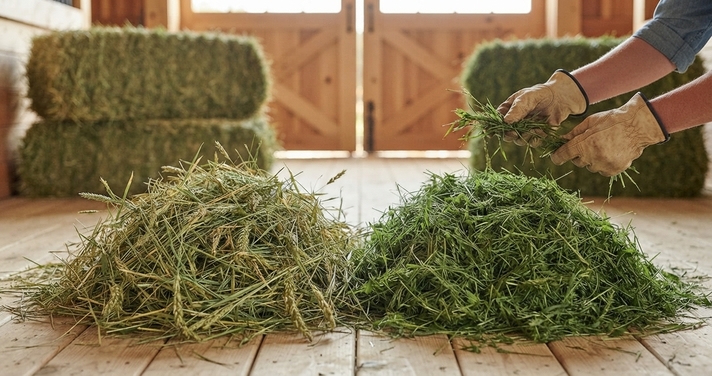
First cut is often coarser, stemmier, and higher in structural fiber. Second cut is usually softer, leafier, more digestible, and somewhat higher in protein and energy.
But there’s an important point to keep in mind: second cut isn’t automatically better.
The type of forage, maturity at harvest, weather, curing, storage, and actual nutrient content all affect hay quality. A well-made first cutting can be a better choice than a poorly harvested second cutting.
For horse owners and other animal keepers, the right choice comes down to the animal’s nutritional needs.
First Cut vs. Second Cut Hay at a Glance
| Factor | First Cut Hay | Second Cut Hay |
|---|---|---|
| Harvest | First harvest of the growing season | Regrowth harvested after first cut |
| Texture | Usually coarser and stemmier | Usually softer and leafier |
| Fiber | Often higher | Often lower |
| Protein | Often lower | Often higher |
| Digestibility | Often lower | Often higher |
| Energy density | Often lower | Often higher |
| Palatability | Variable | Often highly palatable |
| Yield | Usually higher | Usually lower |
| Seed heads | More likely in mature grass hay | Usually fewer |
| Best fit | Animals needing more forage structure or moderate calories | Animals needing more digestible nutrients |
| Main concern | Can be overly mature or stemmy | Can provide more calories than some animals need |
These are general patterns, not rules. Harvest timing matters more than the cutting label alone.
What Do “First Cut” and “Second Cut” Mean?
First cut and second cut refer to the order in which a field is harvested.
First cut is the first harvest of the growing season. After the plants are cut, they regrow. Farmers then harvest some of this regrowth as second cut hay.
Depending on the climate and growing season, a field might produce a third or even fourth cutting.
There isn’t a universal date for first or second cut. Harvest timing depends on the forage species, weather, rainfall, temperature, irrigation, and farm management.
In some grass-hay systems, second cut arrives roughly six to eight weeks after first cut. The exact timing varies from one farm and growing season to another.
Why Does the Cutting Affect Hay Quality?
Plants change as they mature.
During the first growth cycle, forage often has more time to develop stems and structural fiber before harvest. As maturity increases, yield tends to increase while digestibility and nutritional quality decline.
After the first harvest, regrowth is often younger and leafier. When harvested at the right stage, this produces softer hay with finer stems and greater digestibility.
That explains why second cut has a reputation for being the premium option.
Still, the cutting number only tells part of the story.
First Cut Hay: What to Expect
First cut hay comes from the first major growth of the season.
Since this growth often has more time to mature, first cut tends to contain more stems and structural fiber. Grass hay harvested later in the growth cycle can also contain more seed heads.
A good first cutting can still be excellent forage. It doesn’t need to be soft or extremely leafy to be useful.
Typical Characteristics of First Cut Hay
You’ll often see:
- More visible stems
- A coarser texture
- More mature plant material
- More structural fiber
- Fewer tender leaves compared with a leafy second cutting
- More seed heads when grass is harvested at a mature stage
- Lower digestibility when harvest is delayed
- Plenty of long-stem forage for chewing
Appearance varies from bale to bale. Good first cut can still be green, fragrant, clean, and appealing.
Is First Cut Hay Lower in Nutrition?
Often, yes, when comparing similar forage harvested at different maturity stages.
A mature first cutting usually contains more structural fiber and has lower digestibility than younger forage.
But first cut doesn’t automatically mean low-quality hay. An early first cutting harvested at the right stage can outperform a later cutting harvested after the plants have become overly mature.
Second Cut Hay: What to Expect
Second cut hay comes from regrowth after the first harvest.
When harvested while the regrowth is still young, second cut is often:
- Leafier
- Softer
- Finer-stemmed
- More palatable
- Lower in structural fiber
- More digestible
- Higher in protein
- Higher in energy
These qualities make second cut popular with animals that need more nutrients from forage.
Purdue Extension also points to properly harvested second-cutting hay as a potentially higher-quality forage source for livestock.
Does Second Cut Hay Have More Protein?
Often, but there isn’t one protein number for all second-cut hay.
Protein depends on the forage species, maturity, soil fertility, weather, harvest timing, and other factors.
For example, alfalfa and timothy have different nutritional profiles even when both are harvested as second cut.
A forage analysis gives you a much clearer picture than the cutting label.
First Cut vs. Second Cut Nutrition
The main difference comes down to the relationship between maturity, fiber, digestibility, and nutrient density.
Fiber
First cut often contains more structural fiber because the plants have had more time to develop stems.
Fiber isn’t a bad thing. Horses and other herbivores need forage, and long-stem fiber supports normal chewing and digestive function.
The issue comes when forage contains more fiber than an animal needs relative to its ability to consume enough nutrients.
Protein
Second cut is frequently higher in crude protein than a more mature first cutting.
Still, forage species make a huge difference. First-cut alfalfa and first-cut timothy don’t have the same nutritional profile.
Don’t use the cutting number as a replacement for forage testing.
Digestibility
Younger forage is generally easier to digest.
As plants mature, stems and structural components increase. Digestibility then tends to fall.
This is one reason a younger second cutting often provides more digestible nutrients.
Energy
Leafier, younger forage often supplies more available energy per unit of dry matter.
This helps animals with higher nutritional requirements. For an easy-keeping horse, though, more energy isn’t always an advantage.
Calories
“More nutritious” doesn’t mean “better for every animal.”
A horse struggling to maintain weight might benefit from nutrient-dense forage.
An easy keeper might do better with forage that provides plenty of chewing and gut fill without supplying excessive calories.
The best hay is the hay that fits the animal.
Why First Cut Isn’t Automatically Worse
This is one of the biggest misconceptions about hay.
The cutting number doesn’t tell you exactly how good the hay is.
Consider two bales.
Bale A: First-cut orchardgrass harvested at an appropriate maturity, properly cured, protected from rain, and stored correctly.
Bale B: Second-cut orchardgrass harvested too late, exposed to rain, and stored with too much moisture.
Bale A could easily be the better choice.
Weather has a major effect on hay quality. Rain after cutting can cause nutrient and yield losses. Poor drying can also create conditions for heating and mold.
Experienced hay buyers look at the whole picture rather than buying according to the cutting label alone.
What Matters More Than the Cutting Number?
When comparing two hays, look at these factors.
1. Forage Species
Timothy, orchardgrass, bermudagrass, alfalfa, clover, and mixed grass-legume hay all have different nutritional profiles.
A second-cut timothy and second-cut alfalfa aren’t interchangeable.
2. Maturity at Harvest
Maturity is one of the strongest indicators of forage quality.
As many grasses mature, stems increase and digestibility declines.
3. Leaf-to-Stem Ratio
Leafy forage generally indicates younger, less mature plants.
More stems often point toward greater maturity.
Visual inspection helps, but laboratory analysis gives you better nutritional information.
4. Weather During Harvest
Rain can reduce forage quality and yield.
Waiting for suitable drying conditions can also allow the crop to become more mature. Hay producers often have to balance harvest timing with safe curing conditions.
5. Storage
Good hay can deteriorate when stored poorly.
Excess moisture can lead to heating and mold. Hay needs appropriate storage conditions to maintain quality.
6. Laboratory Analysis
When nutrition matters, test the hay.
A forage analysis can provide information about:
- Crude protein
- NDF
- ADF
- Digestibility
- Energy
- Other nutrients relevant to the animal
NDF represents much of the structural fiber in forage. Higher ADF is generally associated with lower digestibility.
Which Is Better for Horses?
Neither first cut nor second cut is universally better for horses.
The right choice depends on the horse’s workload, body condition, age, metabolism, and overall diet.
First Cut May Suit Horses That:
- Maintain weight easily
- Need more fibrous forage
- Have modest energy requirements
- Prefer coarser hay
- Benefit from longer chewing time
A mature, stemmier first cutting can work well for an easy keeper when the hay is clean and nutritionally appropriate.
Second Cut May Suit Horses That:
- Need more calories from forage
- Are in heavier work
- Have higher nutritional requirements
- Struggle to maintain body condition
- Prefer soft, leafy hay
- Benefit from more digestible forage
Second cut is also often appealing to selective eaters because of its softer texture and higher palatability.
Still, individual horses respond differently. Body condition and forage analysis should guide the final decision.
First Cut vs. Second Cut for Easy Keepers
Easy keepers gain or maintain weight with relatively little feed.
A highly leafy, nutrient-dense second cut can supply more energy than some of these horses need.
A coarser, more mature first cut can sometimes fit better because it tends to provide more fiber and fewer calories per unit of dry matter.
But don’t assume every first cut is low-calorie. An early-cut first hay can still be nutrient-dense.
For weight management, look at the actual forage analysis rather than relying on the cutting label.
First Cut vs. Second Cut for Performance Horses
Performance horses often have greater energy requirements.
A palatable, digestible second cut can help provide more available nutrients from forage.
That doesn’t mean every performance horse needs second cut. A well-balanced first cut can work perfectly well when its nutrient profile matches the horse’s requirements.
The goal is to meet nutritional needs, not to choose the richest hay available.
First Cut vs. Second Cut for Senior Horses
Senior horses require individual consideration.
Some older horses struggle to chew coarse hay and do better with softer, leafier forage. Others maintain weight easily and need a less energy-dense diet.
Dental health, body condition, chewing ability, and the rest of the diet all matter.
If a senior horse can’t chew long-stem hay properly, switching from first cut to second cut might not solve the problem. A veterinarian or qualified equine nutrition professional can help determine whether another forage form is more suitable.
What About Rabbits and Guinea Pigs?
Cutting differences matter for small herbivores too, but the goal isn’t simply to find the most nutrient-dense hay.
Grass hay is an important source of fiber for rabbits and guinea pigs. Animals also develop preferences for different textures.
First cut is generally coarser and stemmier. Second cut is usually softer and leafier.
A picky rabbit or guinea pig might prefer second cut. Another animal might prefer the coarser texture of first cut.
The appropriate diet depends on the species and individual animal, so cutting should be considered alongside the rest of the diet.
Can You Mix First and Second Cut Hay?
Yes.
Mixing hays can provide a useful balance of texture and nutrient density.
For example, an owner might combine a mature grass hay with a leafier second cutting when the combination better suits the animal.
Know what each hay contributes. If precise nutrition is important, test the individual hays and account for their actual nutrient values.
How to Tell Good First Cut Hay From Poor First Cut Hay
Good first cut hay should have:
- A fresh, pleasant smell
- Little or no dust
- No visible mold
- Minimal foreign material
- Appropriate color for the forage species
- A reasonable leaf-to-stem ratio
- No excessive heating or discoloration
- Good overall bale condition
Be cautious with hay that smells musty, looks moldy, feels excessively damp, or contains significant contamination.
The cutting label doesn’t make poor hay good.
How to Tell Good Second Cut Hay From Poor Second Cut Hay
The same basic checks apply to second cut.
Look for:
- Clean forage
- A fresh smell
- No visible mold
- Minimal dust
- Good color
- A suitable leaf-to-stem ratio
- Proper curing and storage
- Nutrient values appropriate for the animal
A bright green second-cut bale isn’t automatically better than a good first cutting.
Does Second Cut Hay Have More Calories?
Often, but not always.
Second cut is commonly harvested from younger regrowth, which tends to be more digestible and can provide more available energy.
Actual energy content still varies according to forage species, maturity, harvest conditions, and other factors.
If calorie intake matters, use a forage analysis when possible.
Does First Cut Hay Have More Fiber?
Generally, yes, when first cut is more mature than second cut.
Mature plants usually contain more stems and structural fiber.
The important distinction is this: first cut describes harvest order, while maturity describes the plant’s growth stage when harvested.
Those two factors are related, but they aren’t the same.
Why Can Two Bales of the Same Cutting Look So Different?
Because “second cut” doesn’t describe the entire production process.
Two second-cut hays can differ because of:
- Grass species
- Field conditions
- Soil fertility
- Weather
- Harvest date
- Plant maturity
- Legume content
- Drying conditions
- Storage
A forage analysis is therefore more useful for nutritional decisions than the cutting number alone.
A Better Way to Buy Hay
Don’t stop at the question:
“Is this first cut or second cut?”
Ask:
- What forage species is this?
- When was it harvested?
- What was the maturity stage at harvest?
- How leafy is the hay?
- Was it exposed to rain?
- How was it stored?
- Is a forage analysis available?
- What animal is the hay for?
- What are the animal’s nutritional requirements?
- Is the hay clean, dry, and free of mold and excessive dust?
These questions tell you far more than the cutting number.
Choosing Hay by Animal Need
| Animal or situation | Hay worth considering | Why |
|---|---|---|
| Easy-keeping horse | Suitable mature grass hay, often first cut | Often provides more fiber with moderate nutrient density |
| Performance horse | Leafy second cut or another tested suitable hay | Often provides more digestible nutrients |
| Horse needing weight gain | Nutrient-dense forage | Provides more nutrients per unit of forage |
| Horse maintaining weight easily | Moderate-energy grass hay | Helps manage calorie intake |
| Senior horse with chewing difficulty | Softer leafy forage or another appropriate option | Easier to consume, depending on dental health |
| Adult rabbit | Quality grass hay appropriate for the diet | Provides long-stem fiber |
| Guinea pig | Quality grass hay appropriate for the diet | Supports a fiber-rich diet |
| Dairy cattle with high nutrient demands | Suitable high-quality forage | Greater digestibility can support production |
| Dry or maintenance livestock | Appropriate mature forage | High nutrient density isn’t always necessary |
Use this as a starting point, not as a replacement for species-specific feeding guidance or forage testing.
The Biggest Mistake: Choosing by Cutting Alone
The common belief is:
“Second cut is premium and first cut is inferior.”
That’s too simple.
Hay quality depends on maturity, species, weather, harvest timing, drying, storage, and composition. A carefully harvested first cut can be excellent forage.
A poorly harvested second cut can be disappointing.
The better bale is the one that’s clean, properly cured, appropriately mature, nutritionally suitable, and matched to the animal eating it.
How to Choose Between First and Second Cut Hay
Choose First Cut When:
- You want generally more fibrous forage.
- The animal maintains weight easily.
- The first cut was harvested at an appropriate maturity.
- The animal prefers a coarser texture.
- The forage analysis fits the animal’s requirements.
Choose Second Cut When:
- You need more digestible nutrients from forage.
- The animal has higher nutritional requirements.
- A softer, leafier hay is preferred.
- The forage analysis shows a suitable nutrient profile.
- The animal needs help maintaining body condition.
Don’t Choose Based on the Label Alone When:
- The hay is dusty or moldy.
- Harvest or storage conditions are unknown.
- The maturity is inappropriate.
- The nutrient profile doesn’t fit the animal.
- A better-tested option is available.
The Bottom Line
First cut hay vs. second cut hay isn’t a contest between “bad” and “good” hay.
First cut is often coarser, more fibrous, and less nutrient-dense because the plants are more mature at harvest. Second cut is often softer, leafier, more digestible, and higher in protein and energy.
Those are general patterns, not guarantees.
When buying hay for a horse, rabbit, cattle, or another herbivore, start with the animal’s nutritional needs. Then look at the actual forage.
Species, maturity, cleanliness, storage, and forage analysis often matter more than whether a bale is labeled first cut or second cut.
For more forage options, browse the available grass hay, legume hay, and mixed hay categories and compare them based on the animal’s needs.
FAQ
Is second cut hay better than first cut hay?
Not necessarily. Second cut is often softer, leafier, more digestible, and higher in protein and energy. First cut is often coarser and more fibrous. Harvest maturity, forage species, weather, storage, and nutrient analysis can matter more than the cutting number.
Which cut of hay is best for horses?
There isn’t one best cutting for every horse. First cut can suit easy keepers that need more fibrous forage, while nutrient-dense second cut can suit horses with higher energy needs. Body condition and forage analysis should guide the decision.
Is first cut hay good for horses?
Yes. Good-quality first cut can be excellent horse forage. The plant species and maturity at harvest have a major effect on quality.
Is second cut hay higher in protein?
Often, but not always. Protein depends on species, maturity, soil fertility, weather, and harvest timing. A forage analysis provides the most useful answer.
Is first cut hay higher in fiber?
Generally, first cut has more structural fiber when it’s more mature than the second cutting. Greater maturity usually means more stems and lower digestibility.
Is second cut hay higher in calories?
Often. Younger, leafier forage tends to be more digestible and can provide more available energy. Actual energy content varies, so testing is preferable when calorie intake matters.
Which hay is best for an easy keeper?
A suitable mature grass hay, often including a good first cutting, can fit an easy keeper’s diet well. The actual nutrient profile matters more than the cutting label.
Which hay is best for weight gain?
A more digestible, nutrient-dense forage can help an animal needing additional calories. Second cut sometimes fits this role, but actual protein and energy values should guide the decision.
Can you feed first and second cut hay together?
Yes. Mixing hays can work well when the combination matches the animal’s nutritional and palatability needs. Test each hay when precise ration balancing matters.
Does first cut hay have more seed heads?
It can, especially when grass is allowed to mature before harvest. Seed heads depend on species and harvest timing, so they aren’t present in every first cutting.
Why is second cut hay usually softer?
Second cut comes from regrowth after the first harvest and is often harvested at a younger growth stage. Younger forage tends to have more leaves and finer stems.
Can second cut hay be too rich?
Yes. Nutrient-dense second cut can provide more energy than some easy keepers need. The appropriate forage depends on workload, body condition, metabolic needs, and the rest of the diet.
How can I tell if hay is good quality?
Look for clean, properly cured hay with a fresh smell, suitable color, little dust, no visible mold, and a reasonable leaf-to-stem ratio. For nutritional decisions, laboratory analysis is more reliable than appearance alone.
Does the cutting matter more than the type of hay?
Usually not. Forage species and maturity often provide more useful information than cutting number. Timothy, orchardgrass, alfalfa, and mixed grass-legume hays have different nutritional profiles regardless of cutting.
Key Takeaways
- First cut and second cut describe harvest sequence, not a quality grade.
- First cut is often coarser, stemmier, and higher in structural fiber.
- Second cut is often softer, leafier, more digestible, and more nutrient-dense.
- Second cut isn’t automatically better than first cut.
- Plant maturity at harvest strongly affects forage quality.
- Grass species and legume content can matter more than cutting number.
- Weather, curing, and storage can significantly affect hay quality.
- Easy keepers often benefit from suitable moderate-energy grass hay.
- Animals with higher nutritional needs often benefit from more digestible, nutrient-dense forage.
- Forage analysis gives you the clearest picture of what you’re feeding.
